WEEKLY MARKET DIGEST • October 26 – November 02, 2026
TLDR
- Gold fell 2.72% over the week from the Oct 23 close to Oct 30.
- Bitcoin fell 2.24% over the week from the Oct 26 close to Nov 2, with Binance’s $6.3B hack dominating attention.
- Nasdaq fell 2% on the week as investors sold growth stocks tied to AI spending.
- US Treasury yields declined over the week, with the 10-year yield falling 6 bps.
- Next week, Nov 6 Employment Situation and Nov 10 CPI will test whether Fed officials have cover to resume hikes.
Weekly Market Performance
| Asset | Week Open | Week Close | Weekly Change | 1M Change |
|---|---|---|---|---|
| Global Crypto Market Cap | $2.67T | $2.62T | -2.10% | — |
| S&P 500 | 7,623.68 | 7,580.07 | -0.57% | -1.85% |
| Dow Jones | 52,215.16 | 51,770.31 | -0.85% | +1.16% |
| Nasdaq | 25,955.34 | 25,437.00 | -2.00% | -6.45% |
| VIX | 19.45 | 19.42 | -0.03pts | +4.11pts |
| Bitcoin (BTC) | $79,852 | $78,063 | -2.24% | -7.77% |
| Ethereum (ETH) | $2,310 | $2,283 | -1.16% | -14.75% |
Macro Highlights
AI trade strains growth bets: AI spending shifted from an earnings catalyst to a growing funding concern as investors reassessed the returns on massive infrastructure commitments. Technology shares extended their selloff for a second consecutive session, with disappointing earnings from major companies intensifying concerns over the profitability and financing of the AI buildout. Amazon reported trailing-12-month free cash flow of negative $42.4 billion, reflecting elevated capital expenditure largely tied to AI investments. Microsoft launched a bond offering seeking to raise at least $25 billion amid growing financing needs for its infrastructure expansion. Separately, the Financial Times reported that OpenAI cut its fundraising target by $10 billion to approximately $20 billion, at a desired valuation of $1.25 trillion. The Nasdaq fell 2.00% over the week, closing at 25,437.00, as investors reduced exposure to AI-linked technology stocks.
(CNBC) (Financial Times) (Bloomberg)
Fed path stays tilted to hikes: The Fed held rates steady, leaving its next move dependent on incoming inflation and growth data. A CNBC survey ahead of the meeting showed that 93% of respondents expected a pause. The Fed subsequently kept rates unchanged, upgraded its assessment of economic activity to a “strong pace,” and announced that one of its eight policy meetings in 2027 would be dedicated to strategic discussions rather than rate decisions. Chair Kevin Warsh described the period ahead as “information rich,” with incoming data guiding the next decision. Third-quarter real GDP grew at a 3.4% annualized rate, while September core PCE inflation stood at 3.1% year-on-year. Fed Presidents Alberto Musalem and Lorie Logan subsequently called for further monetary tightening, with Logan arguing that at least two additional 25-basis-point hikes were needed. Upcoming Employment Situation and Consumer Price Index releases will be important in determining whether policymakers have sufficient justification to resume rate increases in December.
(CNBC) (Financial Times) (The New York Times)
Iran risk keeps oil supported: Oil ended the week higher as geopolitical supply risks outweighed renewed diplomatic efforts. Qatar continued mediation efforts with Iran, raising hopes of de-escalation and initially pushing crude prices lower. However, reports of possible US military action against Iran following the November 3 midterm elections revived concerns over regional supply disruptions. On Thursday, US military officials briefed President Trump on potential military options, while he continued to weigh renewed strikes against diplomatic alternatives. Shipping risks also intensified, with a tanker struck by explosive devices in the Strait of Hormuz on Friday, highlighting the vulnerability of regional oil flows despite a partial recovery in Gulf exports. Separately, Goldman Sachs raised its December Brent forecast to $105 per barrel and its 2027 average forecast to $88, citing elevated geopolitical supply risks. WTI crude rose 0.82% over the week to $104.12, with the near-term outlook dependent on the trajectory of US-Iran diplomacy, the risk of renewed military action and the resilience of regional oil exports.
Week ahead
- Tue, Nov 3: Job Openings and Labor Turnover Survey (JOLTS) — A decline in job openings would signal softer labour demand and weaken the case for further Fed tightening, while a stronger reading would suggest continued labour-market resilience.
- Fri, Nov 6: Employment Situation — Stronger payroll growth, accelerating wage gains or a lower unemployment rate would support the case for further tightening. Conversely, weaker hiring or rising unemployment would argue for a more cautious approach.
- Tue, Nov 10: Consumer Price Index (CPI) — Higher headline or core inflation would reinforce December rate-hike expectations, while softer core inflation would ease pressure on the Fed to tighten further.
Crypto Highlights
Binance disclosed a record $6.3 billion theft on October 30, froze about $3 billion of stolen funds, set aside more than $6.34 billion to cover losses, and the FBI attributed the hack to North Korea. Withdrawals reopened in phases on November 1 and net outflows reached $5.8 billion against roughly $171 billion in customer assets, while THORChain node operators on November 2 halted swaps on 10 networks including Bitcoin, Ethereum, Solana and Tron after a block reorg bug slowed the hackers.
BTCPay Server on November 2 told operators to shut down servers immediately after reports that unauthorized attackers were draining hot wallets running outdated software, and Trezor on October 30 warned CryptoBilis buyers since March to move funds due to a suspected hardware implant. Keystone disclosed on October 27 that hackers stole a key used to verify wallets as genuine in addition to customer information, while Chainalysis on October 31 said it had hired third-party experts after a cybersecurity incident.
Kalshi’s week began with S&P Dow Jones Indices adding its gauges to the platform and the NBA naming Kalshi and Polymarket preferred exchanges, then Phantom launched Kalshi-powered CFTC-regulated event contracts for US users and Kalshi raised $1 billion at a $40 billion valuation. It now stands with Kalshi expanding through official data partnerships while fighting Utah’s lawsuit seeking up to $60 million in profits, and Polymarket suspended trading on Thursday after a third-party provider was compromised and user funds were drained.
The US OCC on October 26 called on community banks to become payment stablecoin issuers after finalizing rules for the GENIUS Act’s January implementation, and Canada opened a consultation on stablecoins as part of implementing its Stablecoin Act. Ripple won final US approval on October 27 for a national trust bank to manage RLUSD stablecoin reserves and provide digital asset custody, while Tether reported $1.5 billion in Q3 profit and excess reserves near $8 billion on October 30.
DTCC launched tokenization services on October 28, Mirae Asset Securities’ Hong Kong unit issued six-month tokenized notes on Solana under a $3 billion program, and the Bank of England opened a consultation requiring central counterparties to meet liquidity and risk tests for tokenized collateral. Aviva Investors launched a tokenized share class of its $29 billion Sterling fund on the XRP Ledger, Janus Henderson and Centrifuge launched a tokenized Nasdaq-100 fund on Stellar for eligible non-US investors, and Canton Strategic Holdings planned November 2 tokenized stock trading under the SEC’s innovation exemption.
US Spot ETF Flows
| Fund | Weekly Net Flow | Cumulative Inflow | AUM |
|---|---|---|---|
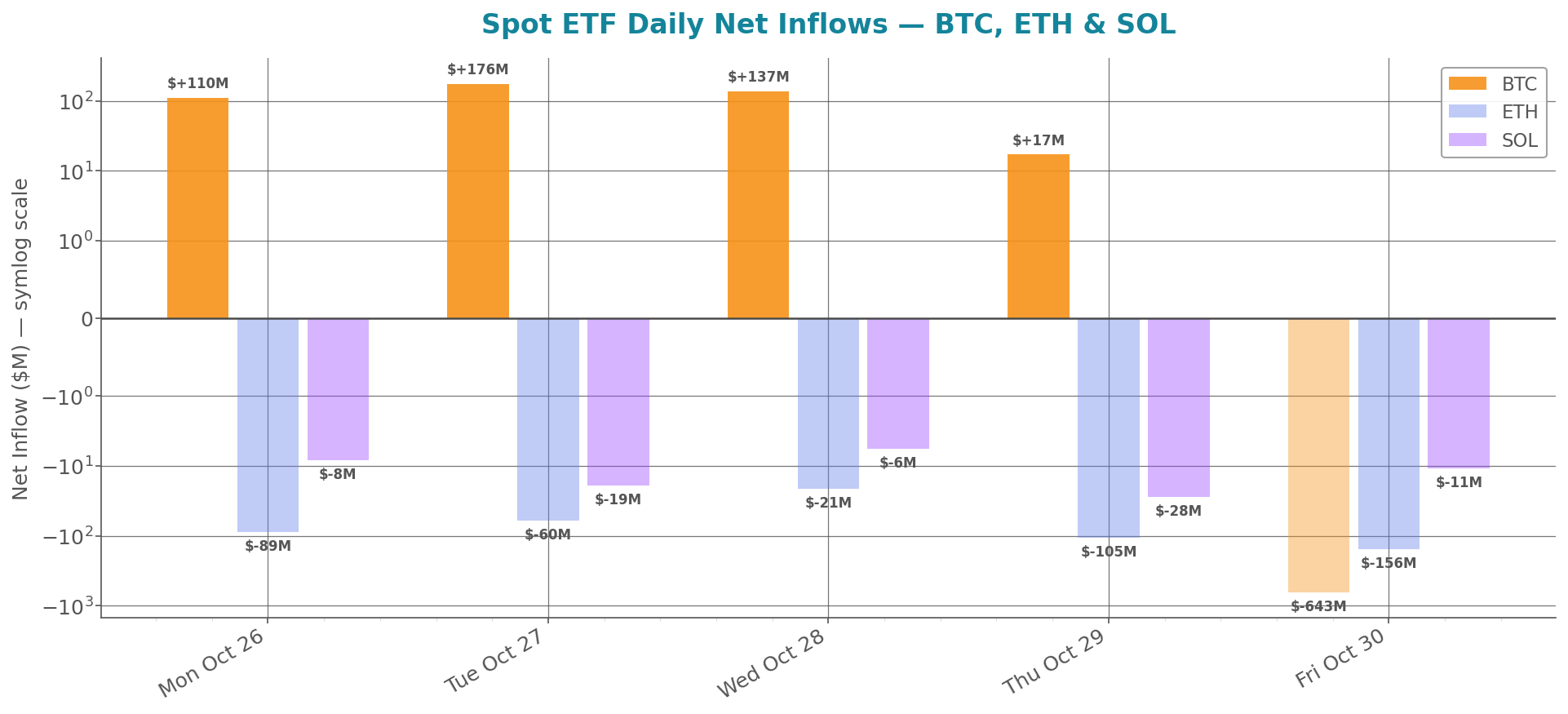
| BTC Spot ETF | $-202.6M | +$56,980.3M | $98.14B |
| ETH Spot ETF | $-431.5M | +$12,287.7M | $13.22B |
| SOL Spot ETF | $-71.5M | +$1,468.7M | $1.40B |
Spot ETF Daily Flows — BTC, ETH & SOL
Cost Basis Distribution & Liquidation Exposure
BTC
ANALYST INTERPRETATION — BTC
1. Positioning & Derivatives Read
Glassnode recorded $407M of BTC perp longs liquidated this week versus $136M of BTC perp shorts, and the BTC long/short liquidation ratio was 3.00. BTC lost 2.24% from the Oct 26 close to the Nov 02 close, so the realised damage sat mainly with leveraged longs rather than shorts.
BTC ETF flows were a $203M weekly net outflow, which means BTC ETF demand was negative during the same week that BTC perp longs absorbed the larger forced unwind.
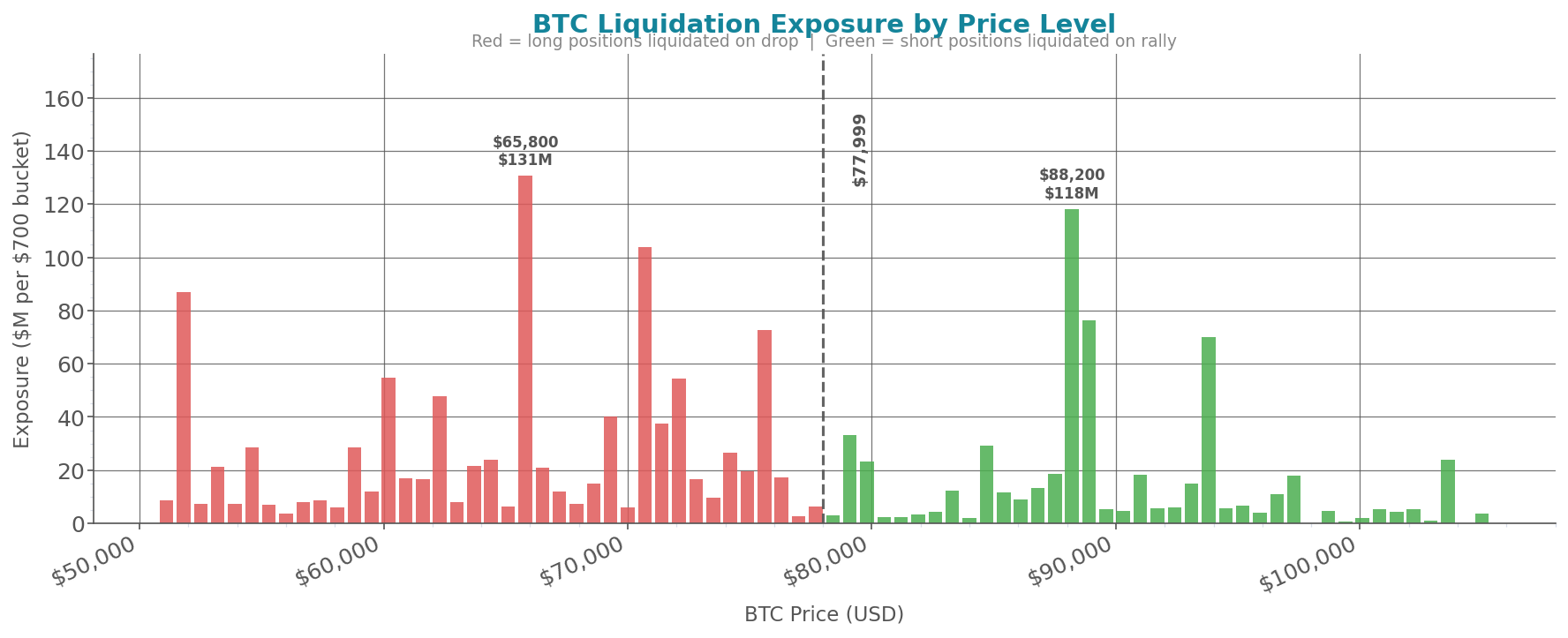
BTC perp liquidations peaked on Thursday at $237M total, concentrating the week’s positioning stress into one session without changing the broader read that longs were the side hit. BTC last-day perp liquidations were $4M of longs and $8M of shorts, with a ratio of 0.52, so the final read into next week is less about fresh realised long pain and more about remaining downside exposure. BTC is still over-extended on the long side, because exposure within 10% of BTC spot is $368M of longs below versus $127M of shorts above, and the LONG side is the more exposed side going into next week.
2. Key Risks & Levels for Next Week
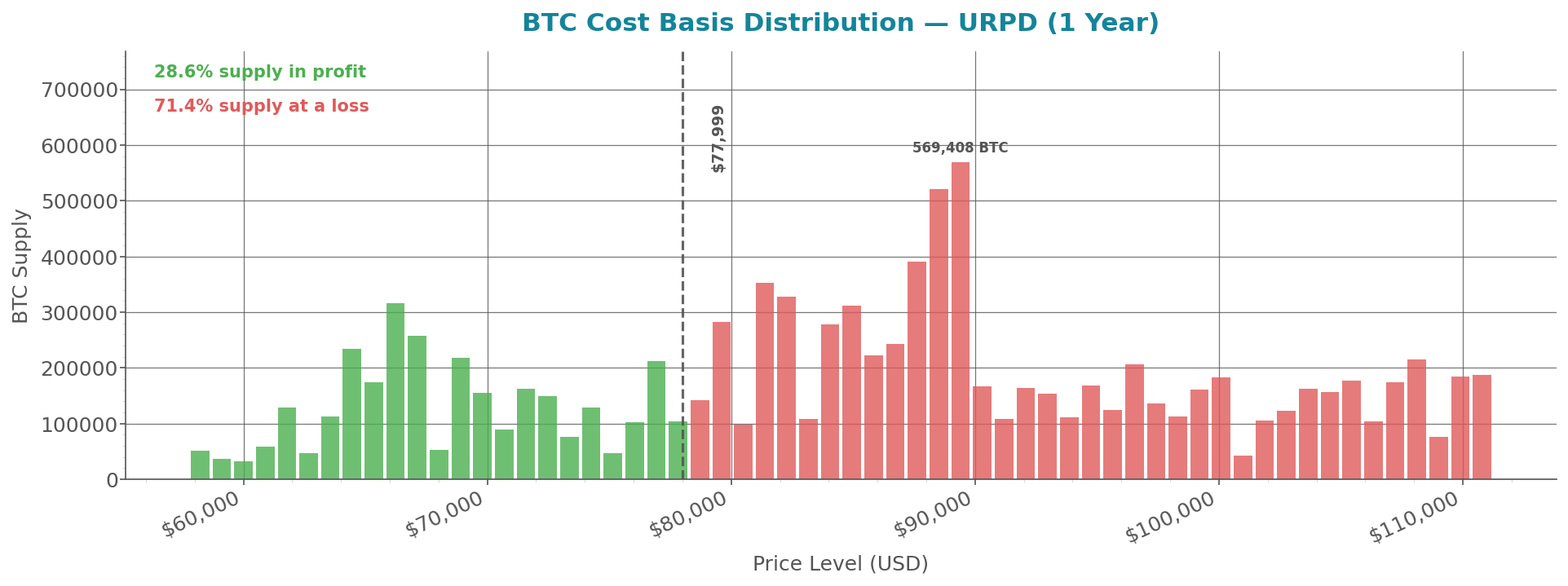
Long Liquidation Risk: The nearest BTC cost-basis cluster below current BTC spot sits at $76,673 with 163,936 BTC, and the nearest BTC liquidation band below sits at $75,600 with $72.8M of longs. The tell is BTC spot volume rising into weakness while BTC perp long liquidations accelerate and BTC ETF flows stay negative.
Near-Term Short Squeeze Risk: BTC spot has resistance at $79,913 with 208,551 BTC held at that cost basis, with BTC short liquidation levels at $79,100 holding $33.1M of shorts and $79,800 holding $23.2M of shorts. The squeeze signal is BTC perp short liquidations rising while BTC ETF flows turn positive and BTC spot volume expands into the $79,100 to $79,913 zone.
Deeper Downside Cascade: Below the first downside band, BTC long liquidation exposure builds at $70,700 with $104.0M of longs and at $65,800 with $130.6M of longs, near BTC cost-basis clusters at $66,952 with 165,313 BTC and $66,412 with 220,286 BTC. The warning sign is BTC perp long liquidation rate accelerating again after the first flush while BTC spot volume remains heavy rather than fading.
ETH
ANALYST INTERPRETATION — ETH
1. Positioning & Derivatives Read
ETH fell 1.16% from the Oct 26 close to the Nov 02 close, and ETH positioning showed forced long reduction rather than balanced de-risking. ETH ETFs had a $432M weekly net outflow, taking cumulative flows to $12.3B against $13.2B of AUM. Glassnode recorded $282M of ETH perp longs liquidated versus $99M of ETH perp shorts liquidated, and the week-total long/short liquidation ratio was 2.85 — more longs were liquidated than shorts this week. ETH perp liquidations peaked on Thursday Oct 29 at $176M total, showing the damage was concentrated rather than evenly spread across the week. ETH Sunday perp liquidations were balanced at $5M longs and $5M shorts, with a 0.99 ratio, leaving the acute forced-long flush less active by the end of the week. ETH is under-extended rather than over-extended after longs were already hit and ETF money left the product, but the larger cascade risk remains below ETH spot because exposure within 10% of ETH spot is $213M of longs below versus $46M of shorts above, and the LONG side is the more exposed one.
2. Key Risks & Levels for Next Week
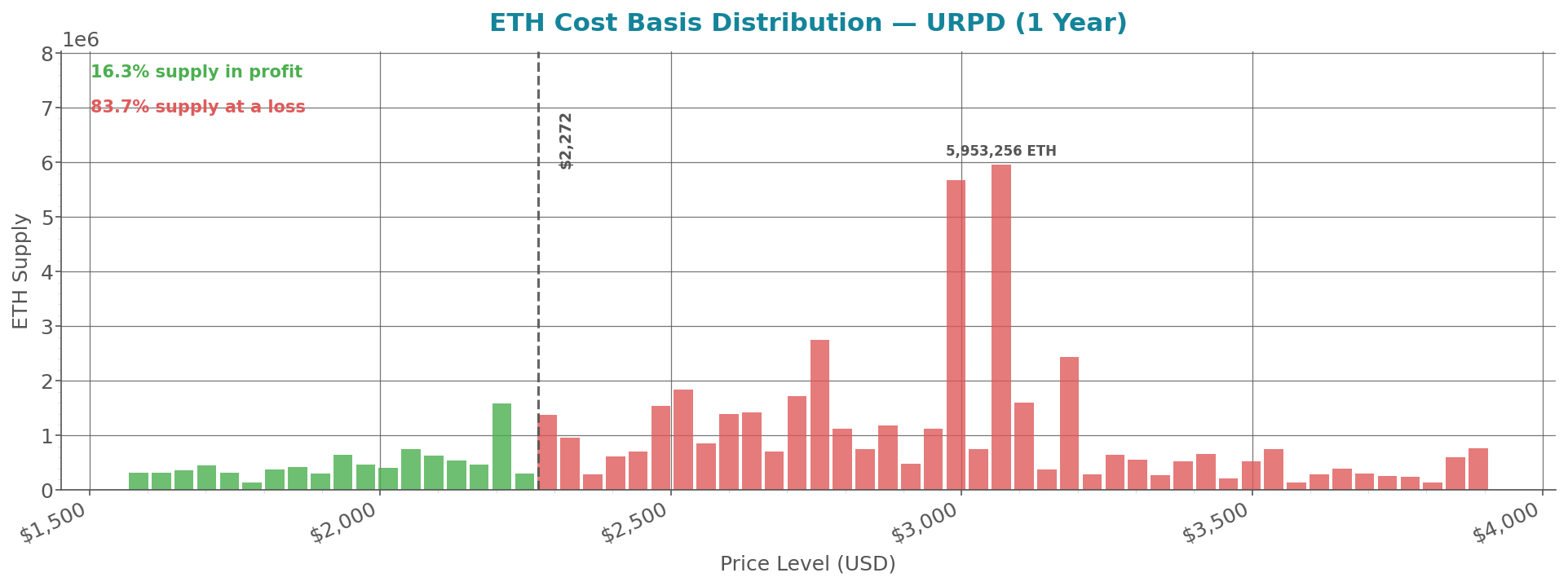
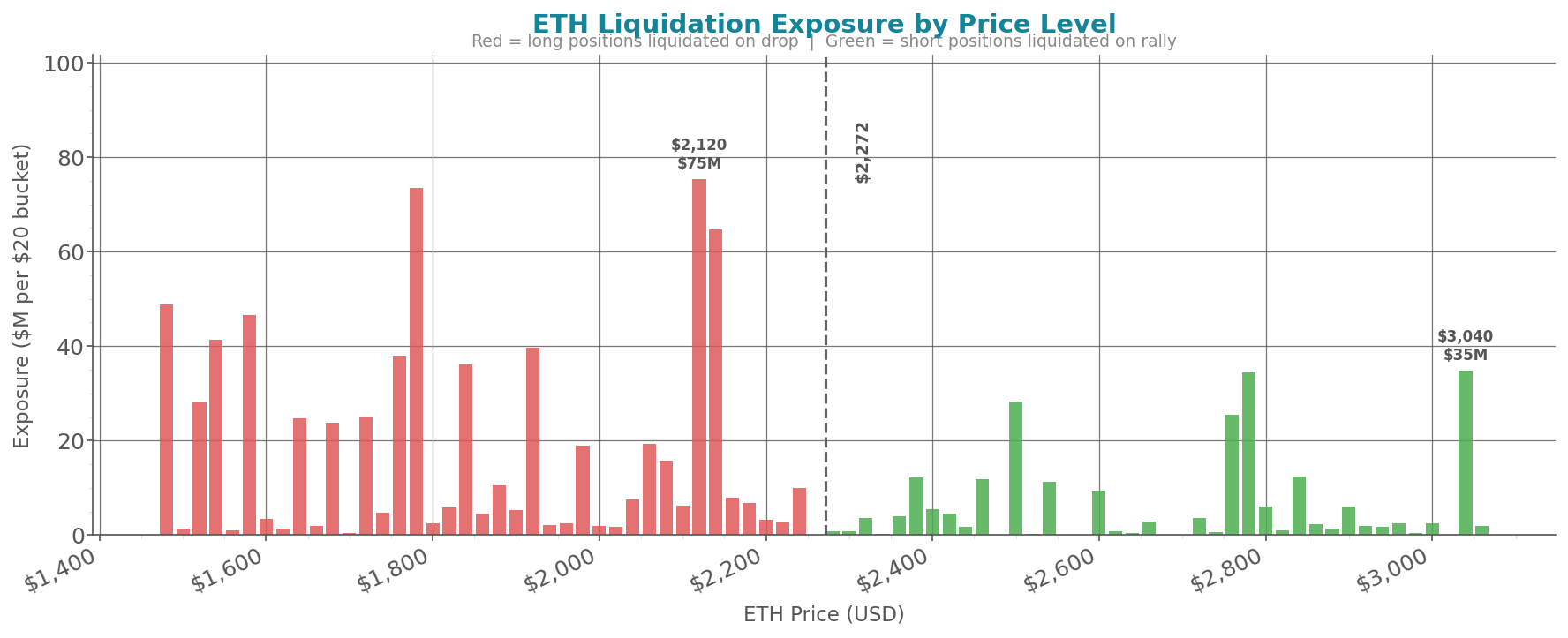
Long Liquidation Risk: ETH spot at $2,272 sits above the nearest meaningful downside liquidation cluster at $2,140, where $64.8M of ETH longs sits, with another $75.4M of ETH longs at $2,120. ETH cost-basis support in the same downside pocket is $2,204 with 1,405,954 ETH and $2,133 with 536,154 ETH, so selling through that pocket puts large holder supply and perp long exposure under pressure together. The signal is ETH spot volume accelerating into the move while ETH perp long liquidations rise faster than shorts, not a daily close after the break.
Deeper Long Cascade: ETH’s next lower liquidation shelf is $1,780, where $73.5M of ETH longs sits, after the $2,140 and $2,120 clusters. ETH cost-basis clusters below current price thin out after $2,133, with 370,214 ETH at $2,062, 388,864 ETH at $2,038 and 402,644 ETH at $2,015, so liquidation risk becomes the cleaner driver once those lower cost-basis pockets fail. The signal is ETH perp liquidation rate accelerating while ETH ETF flows remain negative, showing forced long reduction rather than passive support absorption.
Short Squeeze Into Overhead Supply: The nearest ETH short liquidation levels above ETH spot are $2,380 with $12.2M of shorts, $2,400 with $5.5M and $2,420 with $4.6M, so the first upside squeeze band is shallow compared with downside long exposure. The larger ETH overhead supply starts at $2,772 with 2,075,990 ETH and thickens at $2,985 with 5,022,040 ETH. The signal is ETH ETF flows flipping positive while ETH spot volume expands into $2,380, $2,400 and $2,420, because shorts above ETH spot are liquidated before the larger cost-basis wall at $2,772.
On-Chain Signals — Bitcoin
| Signal | Week-End | Week Chg | Reading |
|---|---|---|---|
| MVRV Ratio | 1.477 | -2.3% | Fair value zone |
| NUPL | 0.325 | -5.2% | Optimism |
| Exch. Net Flow (week total) | -46,603.8 BTC | -52,865.3 BTC | Net outflows — accumulation |
| Exchange Balance (USD) | $261.21B | -3.2% | |
| Perp Funding Rate | +0.00896% | -0.00060pts | Near-neutral |
| Perp Open Interest | $35.51B | -1.1% | |
| 1M Implied Vol | 38.2% | +1.6pts | Low vol environment |
| 25Δ Put/Call Skew | 12.2% | +2.1pts | Slight downside bias (puts bid) |
| Realized Vol (1W) | 30.7% | +2.7pts | Moderate |
| DVOL Index | 40.28 | +4.5% | |
| Accumulation Balance | 2,022,949 BTC | +1.1% | |
| Supply Held ≥100k BTC | 677,124 BTC | -3.9% | |
| Net Realized P/L (week total) | -$1,041.1M | -$4,886.5M | Coins moved at a loss |
Amber rows deviate >1.5σ from prior 4-week baseline • data as of 2026-11-01
Cycle gauges cooled but remained above capitulation: MVRV fell 2.3% to 1.477 and NUPL declined 5.2% to 0.325, indicating a compression in unrealized profits while remaining in positive territory. Derivatives positioning remained relatively subdued, with funding at +0.00896% and open interest down 1.1% to $35.51B. Meanwhile, downside protection demand increased, with 1M implied volatility reaching 38.2% (2.9σ high) and skew rising to 12.2%. On-chain activity showed net exchange outflows of 46,603.8 BTC, while reported exchange balances stood at $261.21B, 3.5σ below their reference level. The accumulation metric increased 1.1%, while realized losses reached $1.041B. Separately, balances held by addresses with at least 100k BTC declined 3.9%. With Bitcoin falling towards $78,000, the indicators point to declining profitability, increased demand for downside protection and elevated realized losses, although aggregate profitability remained positive.
Weekly Market Wrap
Binance’s $6.3 billion security breach was the week’s defining crypto event, shifting attention from institutional adoption and tokenization towards exchange security, asset backing and withdrawal risk. TRM Labs attributed the attack to North Korea’s TraderTraitor group with high confidence, a conclusion subsequently confirmed by the FBI, which urged private-sector firms, including DeFi protocols and cross-chain service providers, to block transactions linked to the stolen assets. Binance said approximately $3 billion had been frozen and committed more than $6.3 billion in company resources to cover the losses. By November 1, the exchange reported that it had replenished approximately 95% of the stolen assets and began restoring withdrawals in phases. The resumption triggered $3.64 billion in net outflows, equivalent to 2.1% of Binance’s assets, during the initial withdrawal period. Although Binance said withdrawals were subsequently stabilizing, the episode highlighted the potential for exchange-security incidents to trigger substantial liquidity and confidence shocks.
US equities ended lower between the October 23 and October 30 closes, with the S&P 500 dropping 0.57%, the Dow Jones dropping 0.85% and the Nasdaq dropping 2.00%. Technology and communication services were the weakest S&P 500 sectors, declining 2.03% and 5.32%, respectively, while health care gained 3.12%. Disappointing technology earnings and concerns over the scale and financing of AI infrastructure investment intensified selling late in the week, with Intel among the biggest individual stock decliners. The Federal Reserve held interest rates unchanged, while Chair Kevin Warsh described the period before December as “information rich”, emphasizing the importance of incoming economic data. Fed Presidents Alberto Musalem and Lorie Logan subsequently argued that further monetary tightening would be necessary. Meanwhile, US real GDP expanded at a 3.4% annualized rate in the third quarter, while September headline PCE inflation accelerated to 3.6% year-on-year, reinforcing the tension between resilient growth and persistent price pressures. Treasury yields declined over the week, with the 10-year yield falling 6 basis points. The dollar index gained 0.07%, WTI crude advanced 0.82%, and the VIX edged down 0.03 index points to 19.42.
European equities outperformed their US counterparts, with the DAX rising 2.53% and the CAC 40 gaining 2.40%. However, euro area GDP growth slowed from 0.6% in the second quarter to 0.4% in the third quarter. The European Central Bank kept its deposit rate unchanged at 2.50%, maintaining a data-dependent approach amid rising energy prices and uncertainty over the inflation outlook.
Crypto assets remained under pressure, with Bitcoin, Ethereum and Solana declining over the reporting period. US spot ETF flows were negative across the three major asset categories during the October 26–30 trading window: Bitcoin ETFs recorded approximately $202 million in net outflows, Ethereum ETFs lost $431 million and Solana ETFs saw outflows of approximately $72 million. Crypto-related equities also weakened, with Coinbase among the notable decliners. The combination of ETF redemptions, weaker token prices and the Binance security incident reinforced a defensive market backdrop.
Institutional and regulatory developments nevertheless continued. Ripple received final approval from the Office of the Comptroller of the Currency to establish a national trust bank, with approved activities including managing RLUSD reserves and providing fiduciary digital asset custody. Separately, Janus Henderson and Centrifuge launched JQQQ, a blockchain-native fund tracking the Nasdaq-100 on Stellar, extending institutional tokenization into listed equity exposure. These developments highlighted the continued expansion of regulated digital-asset infrastructure despite deteriorating short-term market sentiment.
The coming week brings several important market catalysts. The US midterm elections take place on November 3, followed by the October Employment Situation report on November 6. The October Consumer Price Index, due November 10, will provide another important test of the inflation outlook and December Federal Reserve expectations. Apple reports its quarterly results on November 2 after the US market close.
In crypto, attention will remain on Binance’s phased withdrawal restoration, the completion of its asset-replenishment programme and whether post-hack outflows stabilize. Investigators and blockchain service providers will also continue efforts to restrict the movement of stolen funds. THORChain’s temporary suspension of swaps across multiple connected networks, including Bitcoin, Ethereum, Solana and Tron, further highlighted the operational and cross-chain risks exposed by the incident. The FBI specifically called on THORChain operators and other service providers to block transactions associated with the North Korean attackers. The key near-term test for the exchange sector will be whether withdrawal activity normalizes and confidence in the security and backing of customer assets is maintained.